
Nikro Air Duct Cleaning in East Village: A Homeowner’s Guide
A lot of East Village homeowners ask us some version of the same question: does the equipment really matter? It does, and more than most people expect. Nikro portable air duct cleaning units are built for commercial HVAC work, so when that equipment shows up in a walk-up apartment, it’s bringing far more extraction capacity than a typical residential job demands. That surplus isn’t waste. It’s the difference between pulling loose dust off a vent cover and actually clearing the duct run behind it.
Below is a plain-language look at what Nikro equipment does, what you should see and hear while it runs, and how to judge whether the crew in your hallway is set up for real work or just making noise. If you’d rather skip the research and have someone take a look, call (855) 952-0316 and we’ll talk through your building.
What Does a Nikro Negative Air Machine Actually Do?
At its simplest, a Nikro negative air machine creates a pressure difference that puts your ductwork under vacuum while the rest of the apartment stays at normal pressure. Air moves toward the machine, not toward your living room. The unit pulls that air through staged HEPA filtration before releasing it back into the space, so what comes out is cleaner than what went in.
Three things matter in that sentence, and they’re worth separating:
- Negative pressure: the whole point is that debris travels into the machine instead of puffing out of a supply register onto your couch. In an East Village apartment, where a duct run might open into a bedroom two feet from a bed, this is the single most important design feature.
- HEPA filtration stages: air passes through progressively finer filters. The final stage captures particles far smaller than what a shop vacuum’s bag will hold. That’s the difference between “I moved the dust” and “I removed the dust.”
- CFM rating: cubic feet per minute is the measure of how much air the unit moves. Commercial-grade machines are rated well above what a single apartment needs, which means the system holds suction even as the filter loads up during the job. A weaker unit starts strong and fades halfway through.
Containment is the practical payoff. In a shared building with neighbors on three sides, keeping debris inside the machine and out of the hallway isn’t a nicety. It’s the whole job.
Why Suction Alone Isn’t Enough: Nikro and Rotary Brush Agitation
Here’s the part most people never hear about. Vacuum pressure moves loose material. It doesn’t move material that has bonded to the duct wall. Years of cooking grease, pet dander that’s gone sticky, and construction dust packed down by airflow all cling to the inside of the sheet metal like a coat of paint.
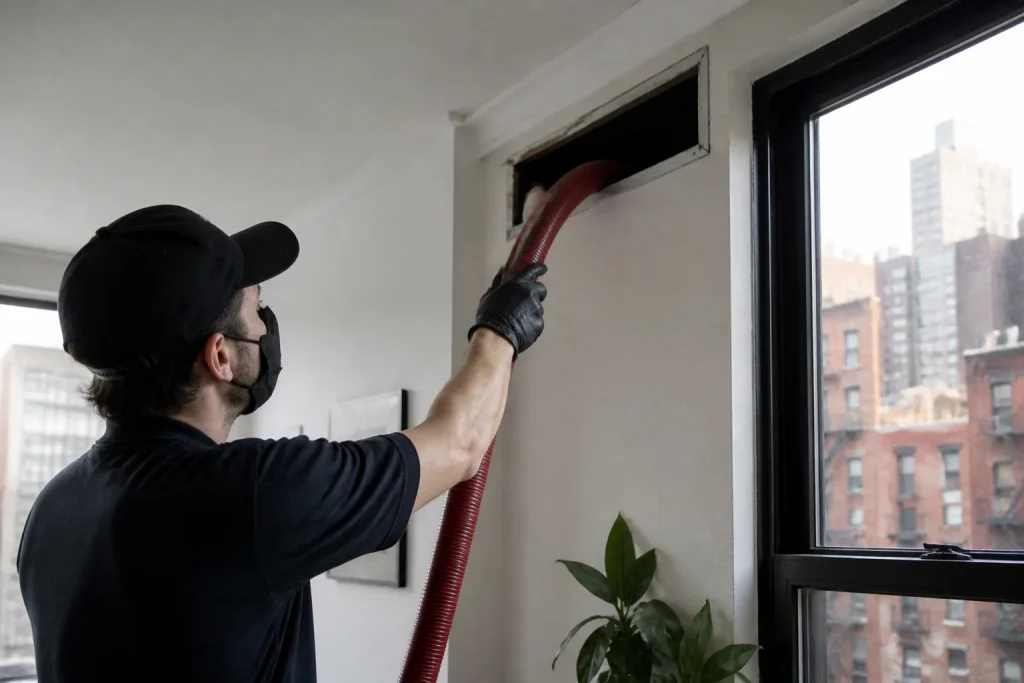
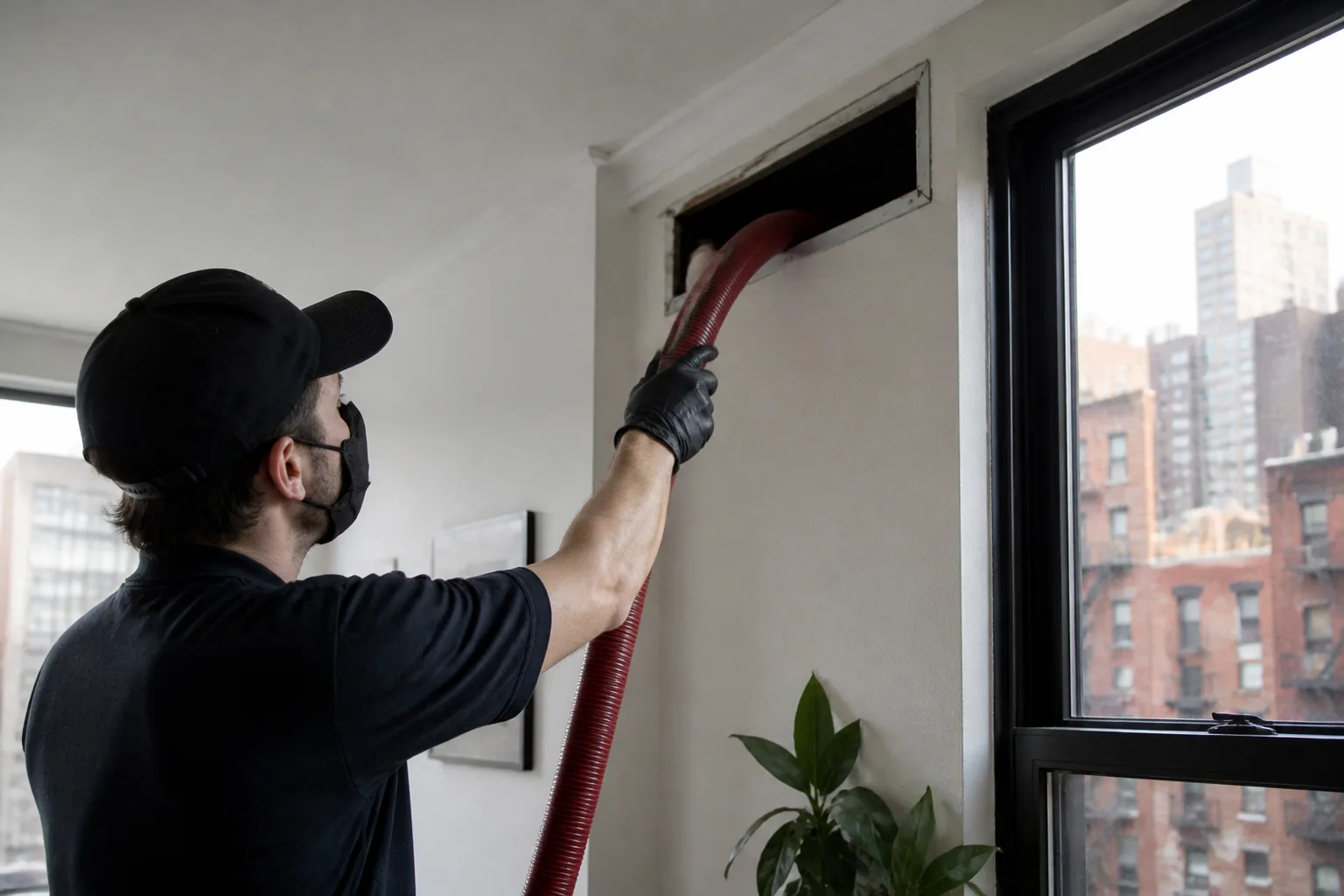
That’s why serious duct cleaning pairs a Nikro extraction unit with a rotary brush system. A flexible whip or brush head spins inside the duct, physically knocking debris off the walls while the vacuum captures it. The two systems work as one: agitation frees material, negative pressure removes it. Run the brush without the vacuum and you aerosolize everything into the apartment. Run the vacuum without the brush and you skim the top layer and leave the rest.
Rotobrush systems are built for exactly this pairing, and that’s why we run both. In East Village housing stock, where ducts have often gone untouched through multiple tenants and at least one renovation, mechanical agitation is usually the difference between a duct that’s genuinely clean and one that just smells less bad for a few weeks. If you want to see how this fits into a full service, our air duct cleaning page walks through the whole process from inspection to final verification.
Owning Nikro Equipment vs. Renting It: What the Difference Signals
This is the comparison question worth asking directly, because it tells you a lot about how a company operates. A crew can rent a negative air machine for a single job. Rental is cheap, and it happens. But a contractor who owns Nikro and Abatement Technologies equipment has made a standing investment in containment-grade capability, which usually means duct and air quality work is a core part of the business rather than a side offering.
Why does that matter to you as a homeowner?
- Familiarity with the tooling. Someone who runs the same machine every week knows its quirks, its filter change intervals, and how to keep suction steady through a long run. Someone renting for the day is learning on your ducts.
- Containment-level expectations. Owning remediation-grade gear signals a shop accustomed to jobs where cross-contamination is unacceptable. That discipline carries over to residential work.
- Follow-through. A company set up for duct repair and sealing alongside cleaning can fix a disconnected joint or a torn flex run it discovers mid-job, instead of noting it and leaving. We handle HVAC cleaning the same way: if the air handler is part of the problem, it gets addressed in the same visit.
None of this is about a brand name on a sticker. It’s about whether the equipment is a daily tool or a prop.
What You Should See and Hear During a Nikro-Based Cleaning in East Village
You don’t need to be an HVAC technician to judge whether a job is going well. A correctly run Nikro-based cleaning produces observable markers. Here’s what to watch for:
- A steady, low machine hum, not a straining whine. The unit should sound consistent from start to finish. A pitch that climbs or a motor that labors usually means a clogged filter or a machine pushed past its capacity.
- Negative pressure you can feel. With the machine running and registers open, a tissue held near an open supply vent should get pulled toward the duct, not pushed away. That’s a quick, honest test anyone can do.
- Containment in place before work starts. Look for plastic sheeting or a zip door at the work area, and hoses running to the machine rather than loose debris on the floor.
- Filter access. The crew should be able to show you the filter stages and explain when the HEPA stage last got changed. A machine with a saturated filter isn’t filtering much of anything.
- Before-and-after photos of your own ducts. A camera run inside the duct before and after agitation is the single clearest proof of what changed. Ask for it up front.
In an East Village apartment, also watch the hallway. Hoses should be routed so they don’t block a stairwell or a fire exit during the work. Small thing, but it tells you whether a crew thinks about the building or only the unit.
How HEPA Capture Handles Common East Village Contamination
The particulate load in East Village apartments tends to be a specific mix, and it’s useful to understand how HEPA capture addresses each type.
Construction dust is the big one. Renovations happen constantly in this neighborhood, and fine gypsum and silica dust migrates through shared ductwork and settles in return runs. It’s abrasive and it’s respirable, which makes containment genuinely important. HEPA filtration captures these fine particles at the machine rather than redistributing them.
Pet dander behaves differently. It’s light enough to stay airborne and sticky enough to cling to duct walls, which is exactly the combination that requires brush agitation followed by high-CFM capture. Suction alone tends to stir it rather than remove it.
Urban particulate comes in from the street through windows and door gaps, then gets pulled into return air and deposited in the system over time. It’s cumulative. A duct network that hasn’t been cleaned in years in a dense, high-traffic neighborhood is holding a real load of it.
Where the contamination has been significant, we finish with sanitizing to address what filtration can’t remove, and often pair that with Aprilaire or Honeywell filtration upgrades so the next round of particulate gets caught at the air handler instead of settling in the ducts again. For dryer-side lint and fire risk, dryer vent cleaning addresses a separate problem entirely and is worth scheduling alongside a duct visit.
When to Call a Pro Instead of Checking It Yourself
A tissue test and a visual look at your registers are reasonable. Beyond that, the work involves confined duct runs, powered rotating equipment, and in some buildings shared mechanical systems where a mistake affects neighbors. If you’re seeing persistent dust on surfaces after cleaning, a musty smell that returns within days, visible debris at the registers, or you’ve just finished a renovation, it’s time for an assessment. The same is true if your HVAC airflow has dropped noticeably without an obvious filter issue.
One honest note: our technicians have up to 15 years of experience, and in that time the most common problem we find isn’t dirty ducts. It’s disconnected or unsealed joints quietly dumping air into a wall cavity. Cleaning without checking the seals can leave you with a spotless duct and the same dust problem.
The Bottom Line
Nikro equipment matters for three concrete reasons: it holds negative pressure so debris goes into the machine instead of your apartment, it pairs with rotary brush agitation to remove material suction alone can’t touch, and it signals a contractor set up for containment-grade work rather than a one-job rental. When you’re evaluating a quote in East Village, ask what machine they run, ask to see the HEPA stages, and ask for before-and-after photos of your own ducts. The answers tell you most of what you need to know.
We run our own process the same way, from cleaning through sealing and filtration. If you’re in East Village and want an honest assessment, we offer free estimates with one flat price per system agreed before any work starts. Call (855) 952-0316 to schedule. We answer 24/7. Fast dispatch from 7am to 7pm, Sunday through Friday.
Frequently Asked Questions
Yes, by a wide margin. A shop vacuum isn’t designed to hold negative pressure across a duct run, and its filtration doesn’t capture fine particulate the way staged HEPA filtration does. Nikro units are built for commercial HVAC work, so they hold suction through the whole job and keep debris contained. If a contractor shows up with a household vacuum, that’s your answer about the scope of the service.
Ask for before-and-after photos from a camera run inside the ducts, not just at the register grilles. A legitimate cleaning involves rotary brush agitation through the full run plus negative pressure capture, and both should be visible to you. If a crew can’t show you the inside of the duct before and after, the work is unverified.
Often, yes. Renovation dust is fine, abrasive, and easily drawn into return ducts, where it settles and recirculates for months. If the work involved sanding, drywall, or demolition anywhere near the mechanical system, an inspection is worth doing. The same applies if you’ve noticed more dust settling on surfaces since the renovation wrapped.
There’s no universal interval. It depends on your building, whether you have pets, how much renovation happens nearby, and whether you’re seeing symptoms like returning musty smells or excess surface dust. An inspection tells you more than a calendar does. If it’s been years since the last cleaning, start with an assessment. Call (855) 952-0316 for a free estimate.
Written by the team at Air Duct Cleaning East Village.
Need Air Duct Cleaning Help?
Call Air Duct Cleaning East Village - the local pro we connect you with is licensed and insured, here with fast help in East Village.
(855) 952-0316